
Choosing a learning management system (LMS) is about more than comparing feature lists. Nearly every platform out there promises course design abilities, reporting capabilities, integration with all your other platforms, and mobile/virtual learning. The real question you need to ask is whether or not those features solve the day-to-day challenges of your organization.
The right LMS benefits both learners and administrators. Learners can easily find and complete training courses, and administrators have the tools they need to manage content and track results.
Choosing the ideal LMS starts with understanding which features actually matter for your organization, rather than simply choosing the platform with the longest list of features.
What Is a Learning Management System (LMS), and Why Do Features Matter?
LMS software can help organizations create, deliver, manage, and track online learning. Depending on your organization’s goals, that could include employee onboarding, compliance training, professional development, customer education, or continuing education for association members.
While most LMS platforms offer similar capabilities on paper, the user experience can vary significantly. One platform may make it easy to build courses and generate reports, while another requires multiple workarounds to accomplish the same tasks. Looking beyond marketing claims and evaluating how each feature supports your day-to-day operations can save time, reduce administrative work, and create a better learning experience.
A helpful way to evaluate any LMS is by asking two simple questions:
- Does this feature make learning easier and more engaging for users?
- Does it reduce manual work or improve efficiency for administrators?
If the answer to both is yes, the feature is likely worth prioritizing.
Core LMS Features Every Organization Should Have
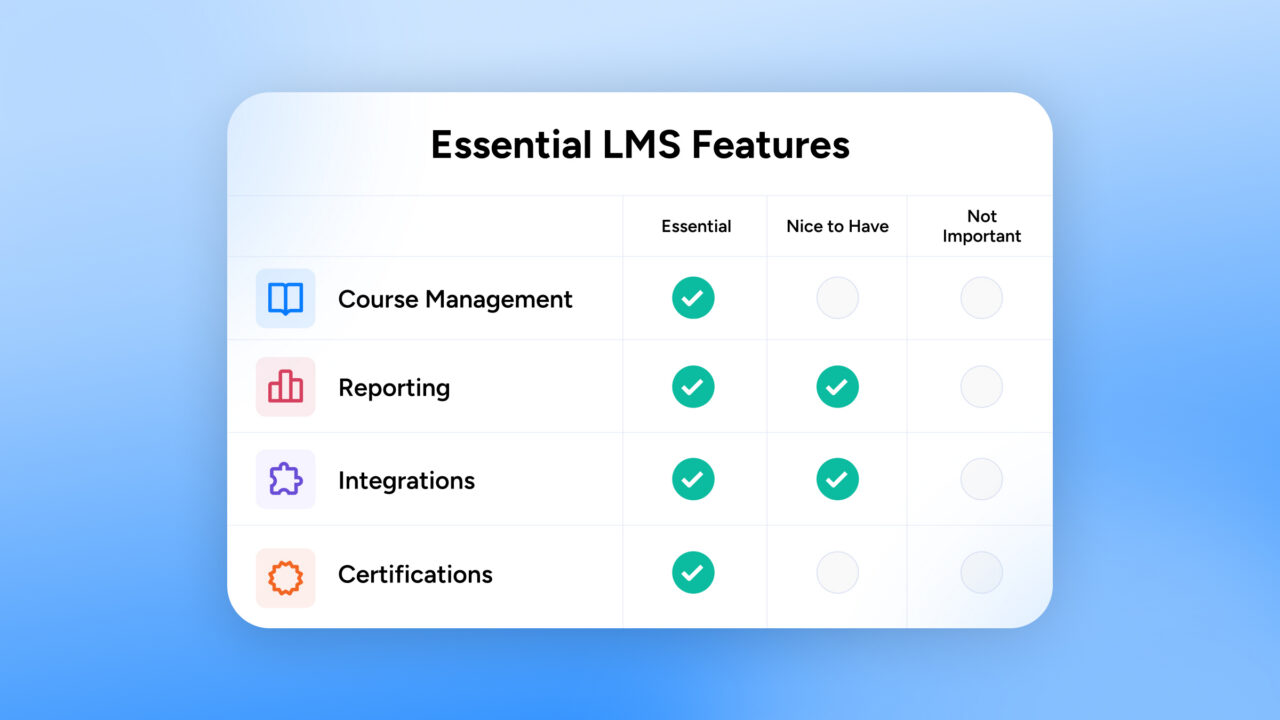
Regardless of your industry or clientele/membership, some LMS features are foundational. Without them, even the most extensive learning platform can become difficult to manage over time. We’ve listed the core LMS features that every LMS should include.
Course Management and Content Creation
An LMS should simplify the process of building and managing your learning content. Because of this, you’ll want to find tools that allow your administrators to not only create courses and upload videos and/or documents, but also organize those lessons into logical paths and update materials without having to start from scratch every time.
An intuitive course management system also makes it easier to reuse existing content, keep information current, and launch new training quickly. As your learning library grows, strong organization tools become even more valuable.
SCORM, xAPI, and Content Compatibility
Organizations will sometimes purchase training content from outside vendors or develop courses using third-party authoring tools. Standards like SCORM and xAPI offer organizations a way to protect their investment in this content, should they decide to switch platforms at any time.
SCORM has long been the industry standard for packaging online learning content, so it works across different LMS platforms. xAPI expands on those capabilities by tracking a wider range of learning activities, including experiences that happen outside traditional online courses.
Assessments, Certifications, and Progress Tracking
Features like proficiency checks and automated certificates help administrators provide clear milestones that learners can work toward.
Expiration date notifications and renewal reminders can save hours of manual tracking for organizations that require ongoing certifications.
Reporting and Analytics
Many LMSs offer custom dashboards that focus your reports on the metrics that matter most to each department, so they don’t have to sift through unnecessary data. The right reporting tools can provide much-needed visibility into:
- Enrollment
- Course completion
- Individual learner progress
- Assessment scores
- Course engagement
Mobile Learning
Whether employees are traveling or working remotely, mobile access to their learning track allows them to complete training at their convenience. A dedicated mobile app with a responsive design and offline learning capabilities can ensure training remains accessible wherever learners happen to be.
Integrations
Most organizations manage everything from employees, customers, and members to communications and payments through various, and often disjointed, systems. An LMS that integrates with other systems reduces repetitive data entry and syncs information across platforms, creating a smoother experience.
Depending on your organization, important integrations might include HR software, CRM platforms, webinar tools, payment processors, marketing automation platforms, or association management software.
Security and Accessibility
Organizations trust their LMS with employee records, member information, certifications, and other sensitive data. Strong security features—including single sign-on, role-based permissions, encryption, and regular security updates—help protect that information while simplifying access for users.
Equally deserving of a shoutout, an LMS that adheres to accessibility guidelines supports learners with diverse abilities and ensures courses can be accessed with assistive technologies, making your courses more inclusive.
Scalability
As your organization adds new departments, locations, groups, or learning initiatives, your training needs will expand. A scalable platform grows with your organization without requiring a complete system replacement every couple of years.
That flexibility is especially important for organizations planning to grow their online learning presence, introduce new certifications, or serve larger audiences over time.
Engagement And Experience Features That Drive Completion
Getting learners into your LMS is one thing. Keeping them engaged long enough to complete courses—and return for future learning—is another.
Focusing on the learner experience means finding features that reduce friction, encourage interaction and participation, and make the material relevant to the learner’s goals.
Personalized Learning Paths
Personalized learning paths can guide people toward the content that’s most relevant to them based on their role, current certifications, past coursework, etc. Instead of asking your learners to sift through dozens of options, the right LMS brings forward what’s most likely to help them next.
Creating a learning experience that feels intentional means tailored experiences for every stage of professional learning, from new graduates and volunteers to C-suite and tenured members.
Social And Community-Powered Learning
People tend to retain more of what they’ve learned when they can share ideas, ask questions, and interact with others who have had similar experiences.
In professional associations, members often join as much for the community as they do for the educational content, so features that keep the conversation going become invaluable. Features like:
- Discussion forums,
- Group workspaces
- Peer feedback
- Message boards
Gamification
It’s important to give learners a sense of momentum with encouraging features like progress bars, online badges, certificates, and milestone tracking.
Positive reinforcement can make an incredible difference, especially in longer certification tracks or extensive continuing education requirements where motivation naturally declines over time.
Blended And Instructor-Led / Virtual Classroom Support
Many associations offer blended learning and mix online modules with live webinars, instructor office hours, or even virtual conferences. Managing everything from registration to certification in separate systems is an administrative nightmare.
An LMS that supports blended learning can house attendance tracking, lesson recordings, and course completion in one place, creating a smoother experience.
Intuitive UI And Branding / White Labeling
A user-friendly LMS needs logical navigation, an intelligent mobile interface, and an intuitive dashboard. Members should be able to find what they’re looking for without digging.
Creating continuity between your website, user portal, and learning platform through white labeling and custom branding makes the LMS feel like an integrated part of your organization rather than a third-party tool.
AI Features Reshaping The Modern LMS
AI has quickly become the headline feature in all technology, including learning technology. The challenge is separating features that genuinely improve the learning experience from those that exist primarily for marketing.
AI-Assisted Authoring And Content Recommendations
Developing quality learning content takes time, especially when subject matter experts already have full-time responsibilities.
AI-assisted authoring can speed up many of the repetitive parts of course development by generating outlines, drafting quiz questions, summarizing source material, or suggesting learning objectives. It’s not a replacement for instructional design or expert review, but it can significantly reduce the time it takes to build and update courses.
On the learner side, modern LMS platforms with these AI capabilities can recommend courses based on previous activity, current certifications, specific interests, or professional goals.
What’s Worth Paying For Vs. AI Hype
The most valuable AI capabilities are often the least flashy. AI tools that deliver a clear return on investment solve everyday problems, such as:
- Reducing administrative work
- Improve search
- Recommending relevant content
- Streamline course creation
If a feature doesn’t save valuable time or improve the learner experience, it’s not worth paying extra for.
Features Associations And Member-Based Organizations Need
Association LMS platforms have to do considerably more than just deliver education courses. They must manage courses and certifications, member vs. non-member pricing, requirements for continuing education, and more, all in one place.
AMS Integration (The Make-Or-Break For Associations)
When your LMS and AMS work together, your staff spend less time maintaining duplicate records, and members benefit from a more seamless experience across systems.
An LMS that integrates with your AMS can automatically sync member records, previous purchases, course history, and certifications.
CE / CEU Credit Tracking And External Credit Claiming
Credit tracking is fundamental for organizations offering continuing education. Your LMS should have the ability to automatically calculate CE or CEU credits, generate certificates, and maintain transcripts.
Some LMS platforms also allow members to submit outside education credits for approval, providing a single place to manage all of their professional development.
The less manual tracking required, the easier it becomes to scale continuing education programs.
Certifications, Credentialing, And Accreditation Pathways
Depending on the certification, learners may need to complete prerequisite courses or earn recurring continuing education credits. Manually managing tasks like practical assessments and annual credential renewals becomes increasingly difficult as programs expand.
An LMS designed for associations should be able to support the entire credential lifecycle—not just course completion.
Member Vs. Non-Member Pricing And E-commerce
Educational content is one of an association’s most valuable member benefits, so flexible pricing matters. The ideal LMS for associations with membership enables automatic member discounts, pricing variations for members and non-members, bundling courses, and subscription options.
Integrated e-commerce also creates a smoother purchasing experience, reducing abandoned registrations and administrative follow-up.
Non-Dues Revenue And Monetizing Learning
For many associations, education has become one of the largest opportunities to diversify revenue. Digital resource libraries, webinars, subscriptions, online courses, and corporate training paths all offer opportunities to generate non-dues income. Ensuring your LMS has strong e-commerce capabilities makes that possible.
How To Prioritize Features For Your Organization
Feature lists are easy to compare, but the best platform isn’t necessarily the one with the longest list of capabilities. It’s the one that fits the way your organization actually operates. Recognize what your organization needs before shopping around.
Need-To-Have Vs. Nice-To-Have: Building Your Checklist
Before you start comparing LMS platform features, determine the problems you have to solve. Do you need better reporting or integrated e-commerce? Continuing education credit tracking or certification workflows?
Separating your organization’s must-haves from flashy nice-to-haves can prevent impressive demo features from outweighing the day-to-day functionality your team needs.
Questions To Ask Vendors Before You Sign
Product demos highlight strengths, but your focus should be on the day-to-day functionality of the LMS. Ask vendors about:
- Implementation timelines
- Reporting flexibility
- Customer support after launch
- Future product development
- Security
- Integrations
- How frequently new features are released
- Examples of organizations with similar learner volumes or certification programs
Finding The Right Fit For Your Association
The right LMS should support far more than course delivery. It should simplify administration, strengthen member engagement, support revenue growth, and give learners an experience they’ll actually want to return to.
The best platform for your association is the one that fits with your existing technology and can grow alongside your organization.
Thrive Learn / Association LMS Demo
A personalized Thrive Learn demo allows your team to explore how the platform supports AMS integration, continuing education, certification management, e-commerce, reporting, and other priorities specific to associations. Rather than watching a generic walkthrough, you’ll see how the platform can fit the way your organization already works.
Frequently Asked Questions
Q: What are the most important features to look for in an LMS?
A: That depends on your organization. For example, an association needs continuing education/certification tracking and AMS integration, while a corporation would focus more on compliance training and HR integrations. That being said, the basic features everyone should have include:
- Course management
- Reporting and analytics
- Mobile learning
- Integrations with your other tools and platforms
- Assessments
- Certification management
Q: What features should an association look for in an LMS?
A: Associations should focus on the features that support member engagement while generating income, such as:
- AMS integration
- CE/CEU tracking and certification management
- Member vs. non-member pricing
- Community features such as message boards
Q: What’s the difference between a corporate LMS and an association LMS?
A: A corporate LMS is designed for employee onboarding, compliance, and professional development, while an LMS that is association-focused includes more features like member education, continuing education credits, certifications, event-related learning, and AMS integrations.
Q: Does our LMS need to integrate with our AMS?
A: The short answer is yes. The long answer is that AMS integration reduces manual work by:
- Syncing member information
- Enabling single sign-on
- Applying member pricing automatically
- Creating a smoother experience
Q: What is CE/CEU tracking in an LMS, and why does it matter?
A: Continuing Education (CE) and Continuing Education Unit (CEU) tracking enables administrators to:
- Record CE credits
- Maintain transcripts for learners
- Issue certifications
- Streamline compliance reporting
This is especially important for industries and professions that require ongoing education to maintain licenses or certifications.
Q: How many LMS features do you actually need?
A: More isn’t always better. The best LMS is one that includes the features your organization will actually use. Start with your core requirements, then look for a platform that can grow with your needs without adding unnecessary complexity.
Q: Is SCORM compliance still important?
A: Yes. SCORM remains the standard for third-party eLearning courses. Compliance with SCORM makes it easier to transfer content between LMS platforms.